
Thinking Preferences Overview

Relevant sections in Living Confidently with Specific Learning Difficulties (SpLDs)

Finding Your Voice with Dyslexia and other SpLDs, 2nd Ed.
1) Chapter 4 Thinking Preferences: p 188-253
2) Using thinking preferences: p156
3) Know your own mind — Recall and checking: pp 56-63

Gaining Knowledge and Skills with Dyslexia and other SpLDs
Differences in thought processing: pp 114-116

Development of Dyslexia and other SpLDs
1) Working memory: p 105-107
2) Finding out how your child thinks well and what motivates him: pp165-172
From Living Confidently with Specific Learning Difficulties (SpLDs)
finding out how you think: website link > materials > videos > state of mind > Know your own mind
Text equivalent of video (video timings)
- plan (0:00)
- why: activity to show people thinking differently (0:53)
- why discuss the way people think (2:22)
- what is included, with very brief descriptions (6:40)
- who might benefit (17:10)
- how to find and develop thinking preferences (18:24)
- when to use thinking preferences - conclusion (26:19)
- connected videos
- references
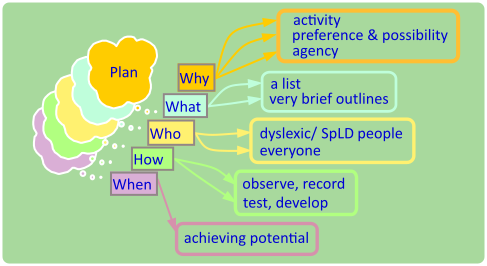
Plan
The video is an overview of:
- why it is important to consider the way people think
- what ways can be useful to consider
- who can benefit from knowing how they think well
- how anyone can discover how a person thinks well
- when to deliberately use one’s best ways of thinking.
There will be brief descriptions of the different ways of thinking; and discussion of being open to further ‘other’ ways as yet unspecified ways of thinking.
First of all, the video has an activity that can show you people thinking differently.
Why: Activity to show people thinking differently
This activity is best done in a group, so find some people to do it with.
Read the following sentence and notice how you are responding to it.
Why: Activity to show people thinking differently
This activity is best done in a group, so find some people to do it with.
Read the following sentence and notice how you are responding to it.
“You can see more seagulls inland these days.”
Pause for a moment to consider what your internal reaction was to this sentence.
If it helps, write key words or a description of how you reacted.
Try the same process with other people, preferably in a group together, and compare internal reactions.
How do any of the possibilities below match your internal reaction? Also consider the thinking preference descriptions later in the video.
Possibilities might be along the following lines:
- visual thinkers will see a picture in their heads
- verbal thinkers may recall a poem or piece of literature about seagulls or the countryside
- kinaesthetic (doing) thinkers may remember or imagine walking through a field with seagulls in it
- intuitive people may be thinking about the ecological reasons for the birds to move from the seaside
- a naturalist could be thinking about the different species of gull and which ones are moving inland.
Why discuss the way people think
There are many other characteristic ways people can internally respond to this sentence, or to any other sentence.
We rarely compare our responses.
We usually don’t notice any patterns to the ways we think.
Our minds may have innate ways of thinking that we are just not noticing.
People’s different responses to the sentence can indicate their individual, instinctive ways of thinking about information and linking information together. One meaning of preference is ‘the liking of one thing rather than another’. To talk about ‘thinking preferences’ is useful when a person’s mind has particular ways of thinking and is not very good at using other ways.
Thinking effectively is an important contribution to agency. Agency is the capacity of an individual to have the power and resources to fulfil their potential.
People with definite thinking preferences gain agency when they know what their preferences are and when to use them.
People with less clear thinking preferences may gain by having more options to choose form.
It is important to use the concept of thinking preferences because:
- some people mind’s have particular ways of thinking: ‘thinking preferences’
- knowing there are many options opens up possibilities when one approach is not effective
- the way anyone thinks can affect processing information well
- understanding a topic can be significantly easier, so can completing a task
- agency is increased when people have choices about how to think.
What is included, with very brief descriptions
Senses: vision, aural and oral, doing (kinaesthetic)
rationale or framework
linear vs holistic
sundry other patterns: episodic memory, anecdotes
Myers Briggs Personality Type (MBPT)
Multiple Intelligences (MI)
NeuroLinguist Programming (NLP)
When the sense component of thinking is the element that holds the thoughts together, then the sense is being used as a thinking preference. With all the senses, there can be internal ways of mentally using the sense.

Vision includes what we see with the physical eyes and what we see with our mind’s eye, I.e. internal vision. Spatial elements of text can be important to those who use the visual sense.

Aural is what we hear and oral what we say, both are linked to verbal processing. Again it is when these elements are key to holding ideas, thoughts or information together that this sense is acting as a thinking preference.
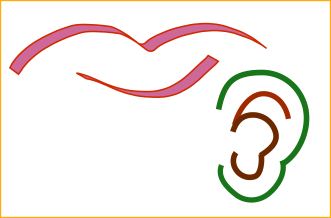
Doing, or kinaesthetic, processing is a preference when the physical element is holding the ideas together. It is important to realise the physical element can be provided internally by the mind.

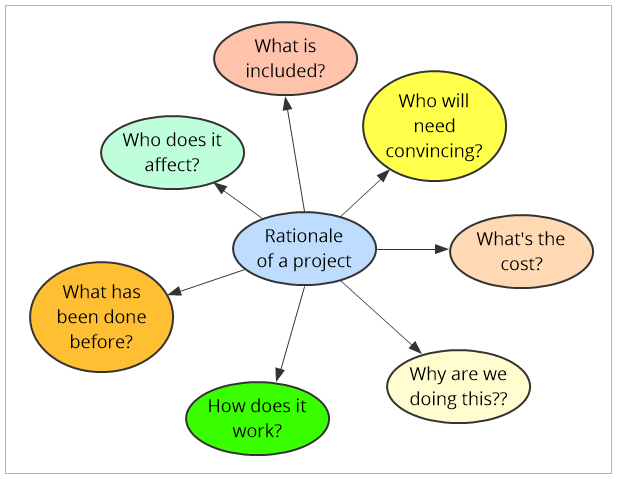
Rationale or frameworks become a thinking preference for those who have to know the structure of information before they receive any of it or can process it.
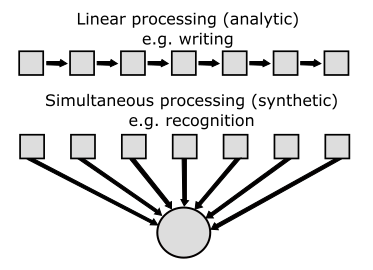
Linear and holistic thinking are characteristically different from each other. In linear thinking, one idea follows from another in a definite sequence. In holistic thinking, a lot of ideas are held together simultaneously. The figure shows the difference.
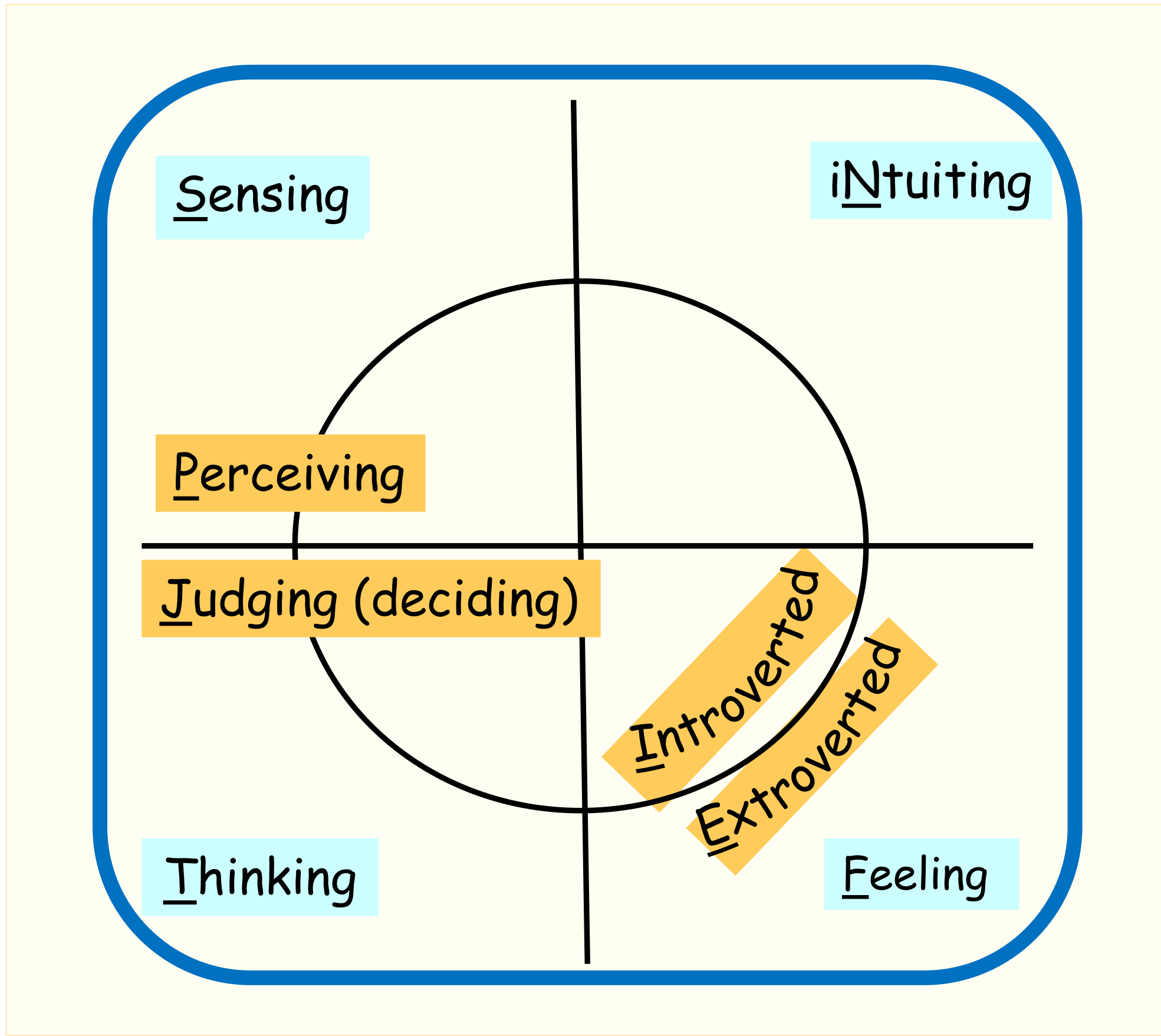
Myers Briggs Personality Type is a comprehensive system for understanding people’s characters. The different ways of interacting with the world can be usefully discussed as thinking preferences.
Multiple Intelligences (MI) is a system of looking at eight independent intelligences, one of which is Natural Intelligence. A characteristic of the Naturalist Intelligence is to realise parallels between ideas, objects or systems that are really quite different. For some people, this characteristic is a thinking preference.
MI:
linguistics & musical
spatial visual &
logical – mathematical
naturalist & body-kinaesthetic
interpersonal & intrapersonal
NeuroLinguistic Programming deals with the way people frame their environment. In the context of thinking preferences, whether the person’s reference point is internal or external can be an important contributor to their thinking preferences.
Sundry other: as we compare the ways we think, we find significant differences that don’t fit any scheme that has been developed. Those that I know of already include: the use of episodic memory and the use of anecdotes.
Other videos on this website discuss the thinking preferences in more detail, including strategies for using them.
Who might benefit
Many dyslexic/ SpLD people that I have worked with have shown me that they have definite thinking preferences and that using the right one for them makes the difference between success and failure.
For them, it is very important to know how to engage the thinking that works best for them. It is also important that other people are supportive of their need to process information in a particular way. Agency, confidence and fulfilling potential are increased when dyslexic/ SpLD people are in charge of the choices.
BUT not every dyslexic/ SpLD person has the same set of thinking preferences. It is good to try out tips from other people, but be very aware that another person’s tip might be disastrous for you. I’ve known too many people fail because they stuck to unsuitable strategies just because they worked for others.

For those without strong preferences knowing the wide range of different ways available opens up possibilities. They can start a task, or topic, thinking in a way that doesn’t fit the flow of the task. There may come a point when they realise the task is not progressing well and then switching to another way of thinking about it can restart progress.

How to find and develop thinking preferences
If you learn or understand by doing, do the steps 1, 2, 3 now
Observation and keeping records are key to finding out how anyone’s mind thinks well.
1) You can make observations using:
- noticing how you respond to sentences like the seagull one above
- how you would use only your mind to remember 5 unconnected objects that you want to buy
- doing the mind exercise in the video Know Your Own Mind
- brainstorming a topic you know and reflecting on the links between different elements
- playing Kim’s game, this can be used with children.
2) Observation is based around questions such as:
- What mental links am I making?
- How am I recalling information?
- What motivates me in any task?
- What language do I use to explain something?
- Do I use objects or drawing to explain something?
3) Then you need to analyse your observations in terms of the thinking preference patterns.
The very brief descriptions of the various thinking preferences will give you some guidance for the analysis. Future videos will give more information. The book Finding Your Voice with Dyslexia and other SpLDs has a fuller discussion, including ways to use the different thinking preferences.
Testing and developing your use of thinking preferences is also important. Have the observations and analysis helped you
- understand topics,
- use your memory more reliably
- do tasks with more competence and confidence?
It is useful to record your experience in some way so that you can build your thinking skills effectively.
The following suggestion is a way of comparing your favourite subject and a less favourite one to test and develop thinking preferences. The same could be done with a hobby and a task you don’t particularly enjoy.
Try recalling part of your favourite subject.
- What links are there between the items you recall?
- Are there processes that you are using?
- What makes the subject a favourite?
Take a less favourite subject. Compare it with the favourite one.
- Is there anything from the favourite subject that you could apply to the less favourite one?
Repeating this comparison many times will develop your use of your thinking preferences.
Anything that doesn’t work is as useful as the things that work. It is also telling you about the way your mind works; in this case it is suggesting ways of thinking that don’t suit you.
You may find you have no particular thinking preferences. For you the important knowledge will be that some people are seriously hampered when they can’t use their best ways of thinking and you will be open to allowing them to think in their best ways.
When to use thinking preferences – conclusion
If you are someone whose mind has definite thinking preferences all mental processes are likely to be easier for you when you deliberately use your best ways of thinking.
You can use your thinking preferences to:
- expand the capacity of your working memory
- capture information
- remember information
- understand a topic or job
- develop ideas
- do a task or job
- recall something from long-term memory
- use many other mental processes.
Knowing how your mind works gives you agency – you are in charge of being able to activate your best ways of thinking.
There are too many variations to expect general communication to be minutely tailored to an individual person’s ways of thinking. There are some general principles that allow enough flexibility for individuals to think as best suits their minds.
Within the flexibility and with your own agency, you have the chance to grow in confidence and to fulfil your potential.
Connected videos
- Know your own mind > State of Mind > Know Your Own Mind; part 1 for the exercise; part 2 for the example.
- A Taste of Dyslexia
- Recall and memory consolidation
- Capacity of working memory
- Mind preparation
- Neurons underpinning dyslexia-SpLD
References
Myers-Briggs Personality Type:
Briggs Myers, Isabel, 1989, Gifts Differing, Consulting Psychologists Press, Palo Alto, CA
Lawrence, Gordon, 1993, People Types and Tiger Stripes, Centre for Applications of Psychological Types, Gainsville, FL, 3rd ed.
Multiple Intelligences:
Smith, Mark K., 2002, 2008, Howard Gardner and multiple intelligences, The encyclopedia of informal education, http://www.infed.org/mobi/howard-gardner-multiple-intelligences-and-education
NeuroLinguistic Programming:
Hoag, John David, nlpls.com/articles/metaPrograms.php (accessed Feb 2026)