
Neurons Underpinning Dyslexia/ SpLDs

Relevant sections in Living Confidently with Specific Learning Difficulties (SpLDs)

Finding Your Voice with Dyslexia and other SpLDs (2nd ed)
Addendum – A Role for Neurons: pp 364 – 377
Neuronal pruning and child learning: pp 4-5
Myelin sheath: p 95
There are many issues that are still debated about the existence of dyslexia/ SpLD. After submitting the manuscript of Finding Your Voice with Dyslexia and other SpLDs, I realised how these issues could be resolved by two neuronal processes: 1) neuronal pruning and 2) neurons wiring together when they fire together.
In this video, I outline:
neuronal pruning as a baby learns
neurons firing and wiring together
how random connections build when expected wiring together is impeded.
I propose the hypothesis that these neuronal processes underpin dyslexia/ SpLD.
I finish by looking at the main questions, especially about dyslexia, and discuss how this hypothesis resolves them.
Baby’s brain, learning and some neuron structure
When a baby is born, the brain has a huge number of neurons and connections: few routes have been established through the brain to respond to the world around.
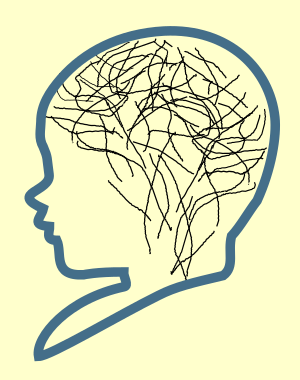
As a baby makes sense of the world around them, certain groups of neurons will be used repeatedly and others will be ignored. The used ones are fed nutrients and become established. The ignored ones are not fed and they die away; this is neuronal pruning.

Good learning has been achieved when the established neurons are those that can be used efficiently to do the task they relate to, for example when there is a group of neurons that produces the correct spelling of a word automatically.
A neuron has a cell body with a nucleus; there are a number of projections called dendrites which branch out from the cell body; there is an axon which carries the signal from the cell to other neurons. The dendrites connect to other neighbouring neurons. The cell body has an electric potential which is modified by the dendrite connections with other neurons. When the potential rises above a certain threshold, the neuron fires and sends a signal down the axon. The signal is then communicated to other neurons through synapses.
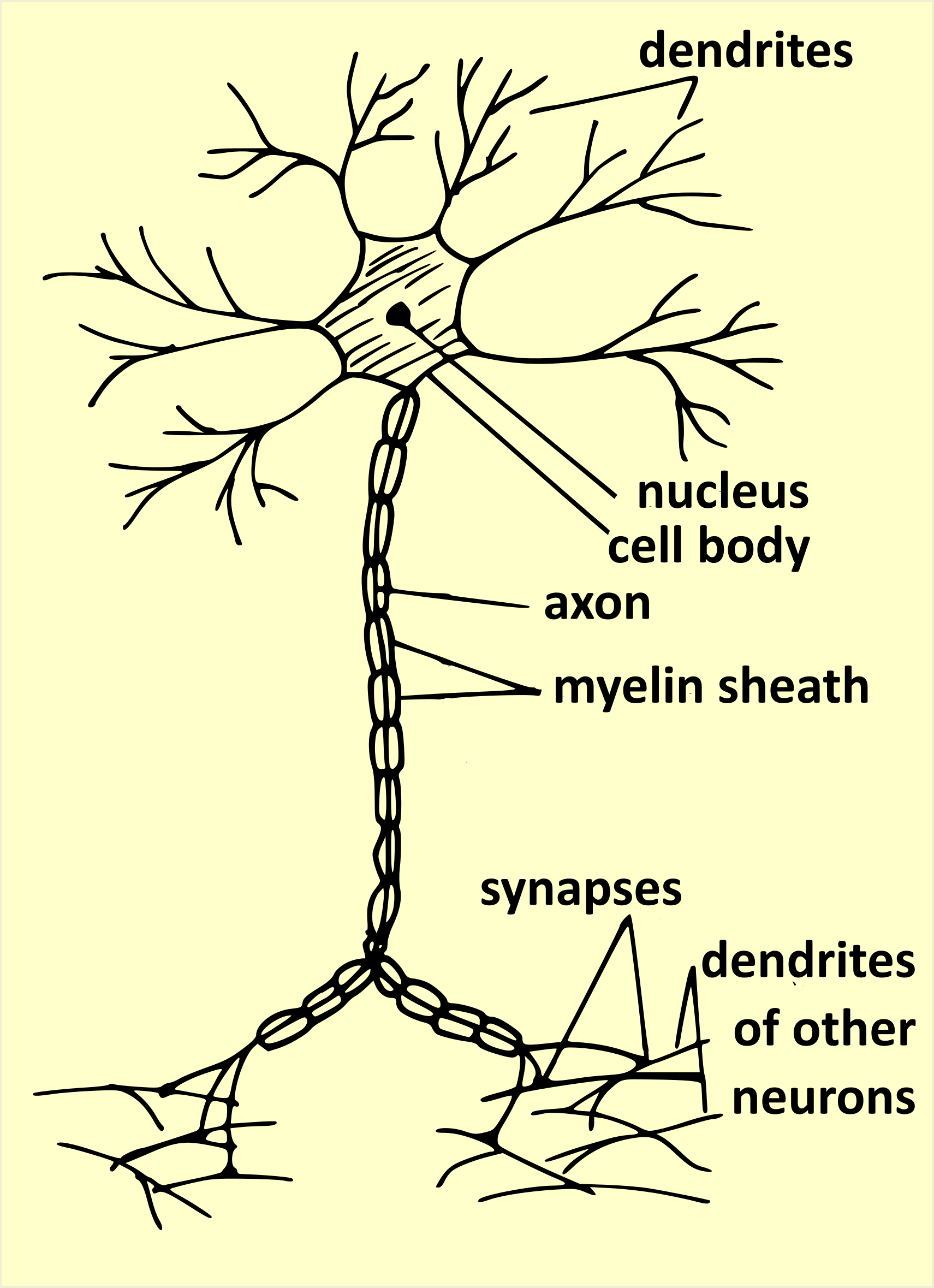
Myelination is another process that happens as the neuronal system develops. As neurons are used, a sheath of myelin builds along the axon. The myelin sheath allows signals to pass along the axon at greater speeds, so that, as learning progresses, tasks get faster and more competent.
When a child comes to school, they have already learnt a lot about the world around them, so there will be many groups of neurons already established. Formal education produces more learning, i.e. more groups of neurons with connections that give expected outcomes.
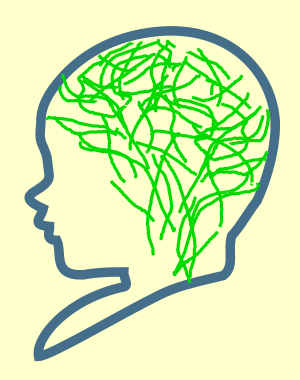
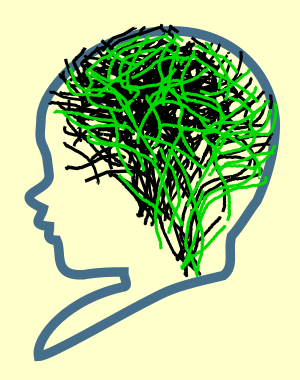
Dyslexic/ SpLD learning does not settle to the hoped for efficient groups of neurons, and neuronal pruning does not happen to the expected level. For example, spelling a word is not reduced to a single, correct option but many variations become established. Later, the correct learning can happen, but it does not get rid of the matured dyslexic/ SpLD learning. The matured dyslexic/ SpLD learning can be activated at any moment in the future, despite the presence of correct learning.
Neurons connecting
A group of neurons acting together is referred to as a neuronal ‘assembly’ or ‘population’, and can be represented in diagrams by a single neuron.
Firing together happens when the signal from one neuron takes the potential of another neuron over its threshold and the second neuron fires. As this happens repeatedly, the synapses connecting the neurons change in a way that allows the firing together to happen faster and more readily, resulting in the neurons being wired together.
The figure shows neuronal assemble A firing, connecting to neuronal assembly B, taking the potential of B above the threshold, so that in turn B fires. The synapses are shown as blobs to indicate that the connections have been repeated to the point that the synapses’ structures have changed and the two assemblies have become wired together.

Random connections
The figure shows 3 neuronal assemblies, A, B and C. C has a greater impact on B than A; this is indicated by the larger synapse-blobs in the figure. A fires and increases the potential of B, but C is having a negative effect on B’s potential and stops B from firing when A fires. In this case B will not fire with A and the two will not become wired together. A-B represents the route for the required learning; this learning is not going to happen when C prevents B from firing with A.
The signal from A will also be altering the potential of other neurons at the end of the axon. It will trigger other responses in the neighbourhood of B; think of the random attempts at spelling that get established in dyslexic people’s brains. These other responses don’t gravitate to the desired learning, but they do get used over and over again. So they will become established and not pruned out. I’m calling them ‘random connections’ because they do not produce the learning outcomes of educational tasks.
The process of myelination depends on repeated use and not whether an assembly of neurons is producing the required learning, so myelination will happen to these ‘random connections’.
‘Practice makes permanent’ has replaced ‘practice makes perfect’. The repeated use of the random connections will make them permanent. These random connections are manifested in the behaviours of dyslexia/ SpLD; they are the underpinning of dyslexia/ SpLD.
Later learning can be achieved in a different way so that the neural wiring equivalent to A-B gets established, but it doesn’t replace the random connections once they have matured.
Hypothesis
The hypothesis presented here is that:
1. there are constitutional elements and psychological characteristics that mean a child can be ‘at risk’ of dyslexia/ SpLD developing in their brain
2. dyslexia/ SpLD becomes established from random connections being repeatedly used; the random connections arise when expected neural connections are repeatedly interrupted and inhibited; neuronal pruning and neuronal firing-and-wiring together result in the repeated random connections maturing and being well-established, i.e. dyslexia/ SpLD matures
3. the developed dyslexia/ SpLD is observed through a variety of resulting behaviours
4. correct later learning does not replace the matured dyslexia/ SpLD.
Point 2 is the new hypothesis. The others provide the context. Points 1 and 3 are well known. Point 4 has been voiced before, though not widely discussed.
The hypothesis has two strands: 1) neuronal processes underpinning dyslexia/ SpLD; 2) influences that interrupt and inhibit the usual development. The subject of this video is strand 1, the establishment of dyslexia/ SpLD.
Strand 2 will be the subject of future videos. Briefly, the interruptions and inhibitions are likely to be, in:
- dyslexia, not learning the right way for the individual
- dyspraxia, not having a stable body-frame
- AD(H)D, not having a fixed focus
- dyscalculia, no suggestions; I have not supported anyone with dyscalculia; I have some symptoms but I’m not a maths teacher.
Questions and discussion
Questions
The questions about dyslexia/ SpLD addressed by this hypothesis are:
1 Does dyslexia exist?
2 Is there a cure?
3 What is dyslexia?
4 Can one usefully talk about mild, moderate and severe dyslexia/ SpLD?
5 Does intelligence matter for the definition of dyslexia/ SpLD?
6 What is the difference between dyslexic people and non-dyslexic poor‑readers?
7 Are the interventions the same or different for dyslexic people and non-dyslexic poor‑readers?
8 Why is there so much co-occurrence among the various SpLDs?
9 Why are there so many variations, of problems and solutions?
10 How useful are labels?
11 Does dyslexia/ SpLD have an impact beyond just reading and spelling?
12 Would the benefits of dyslexia disappear if we could avoid dyslexia developing?
13 Why should resources be diverted to support dyslexic/ SpLD people?
Dyslexia was the first SpLD to be observed. The others slowly separated away from dyslexia as groups of behaviours didn’t fit the main language basis of dyslexia. They are all grouped together as they have similarities in problems, needs and solutions. The questions are mostly about dyslexia, but the answers are also relevant to the other SpLDs.
Discusion
1 Does dyslexia exist?
2 Is there a cure?
3 What is dyslexia?
This hypothesis is proposing that the matured ‘random connections’, discussed above, are the resulting dyslexic network that produces the behaviours symptomatic of dyslexia; so, yes it exists once it has matured into being and no it can’t be cured because it has matured passed the pruning stage of development.
4 Can one usefully talk about mild, moderate and severe dyslexia/ SpLD?
Dyslexia/ SpLD are not steady state syndromes: unlike long- or short-sightedness, you cannot prescribe even a temporary fix that will deal with symptoms. So the range mild, moderate, severe does not describe the real experience. Someone may be a highly compensated dyslexic/ SpLD with many strategies for dealing with the problems, but something triggers the dyslexia/ SpLD and that person can be as badly impacted as when they were a child. Dyslexia/ SpLD seen as a collection of random connections available to be activated at any time explains this kind of experience.
5 Does intelligence matter for the definition of dyslexia/ SpLD?
6 What is the difference between dyslexic people and non-dyslexic poor‑readers?
7 Are the interventions the same or different for dyslexic people and non-dyslexic poor‑readers?
The role of intelligence in the description of dyslexia/ SpLD changes with time. As of 2024, it is back again in the second point of the definition of dyslexia: In dyslexia, some or all aspects of literacy attainment are weak in relation to [..] and level of other attainments (Holden, et al., 2024). What does an intelligent person do when a task is not working for them? Find another way to do it or find a way to avoid it. The other way of doing the task can miss the learning intended and can create the random connections and, with use, the matured dyslexia/ SpLD develops.
Non-dyslexic poor readers make slow progress with most of their learning; they are not inventing other ways to do tasks; they are not creating and maturing the random connections. For them, dyslexia/ SpLD does not develop. This is the difference between dyslexic readers and non-dyslexic poor readers within this hypothesis.
The interventions available for both dyslexic/ SpLD people and non-dyslexic/ SpLD poor readers may well be the same, but the individual way they are absorbed will be different. In this hypothesis, for non-dyslexic/ SpLD poor readers the connection A-B is slow to wire together but does not experience any impact from a C neuron assembly.
8 Why is there so much co-occurrence among the various SpLDs?
9 Why are there so many variations, of problems and solutions?
10 How useful are labels?
This hypothesis is about random connections developing because required routes, such as that represented by A-B, do not become established. The way these random connections develop will depend on the experiences of each individual. We all grow up with different brain connections, even identical twins in the same household have differences. So the overlap between different SpLDs is not surprising; nor are variations of problems and solutions.
The labels are useful in that they indicate a need and a probable source of something not connecting as expected. However, the solutions are not found in the problem but in channelling what an individual does well.
11 Does dyslexia/ SpLD have an impact beyond just reading and spelling?
You only have one brain and mind; everything you approach in life has to use that brain/ mind. Specific learning difficulty can impact anything you have to learn: a new computer operating system, the new setup in the supermarket, a new layout in the office, a new building tool; anything new, but also other aspects of everyday life. They just usually manifest first in spelling and reading.
12 Would the benefits of dyslexia disappear if we could avoid dyslexia developing?
13 Why should resources be diverted to support dyslexic/ SpLD people?
Several successful dyslexic people enjoy their unorthodox thinking and say that dyslexia is a price worth paying to have them. There is then a worry that these would disappear if dyslexia could be avoided. Supporting students with dyslexia/ SpLD is often based on finding these unorthodox ways of thinking; they won’t disappear, they need to be recognised and used at the beginning of education.
Resources should not be diverted to support dyslexic/ SpLD students. What is vital in the learning and teaching for dyslexic/ SpLD students is good practice for very many others. So catering for the dyslexic/ SpLD group should enhance the learning environment for a great number of others and not divert resources.
Final thoughts
A hypothesis: proposes a new theory or model; answers starting questions; and indicates future development. The first two have been the subject of the video and this text. How to respond to the neurons represented by C will be in other videos.
Immediate final thoughts are that:
- observing and responding has to start early
- agency needs to be given to unorthodox thinkers
- what’s vital for dyslexic/ SpLD people is good practice for all
- catering for dyslexic/ SpLD children has been done successfully in primary state schools
- such early catering is emotionally, socially, and financially cost effective.
Connected videos
- A Taste of Dyslexia
- Input channels – capturing information
- Symbols and icons
References
*Carroll, J., Holden, C, Kirby, P., Thompson, P.A., & Snowling, M.J., the Dyslexia Delphi Panel, 2025 Toward a consensus on dyslexia: findings from a Delphi study, Journal of Child Psychology and Psychiatry Open Access https://doi.org/10.1111/jcpp.14123
Elliott, Julian G., and Grigorenko, Elena L., 2014, The Dyslexia Debate, Cambridge University Press, NY
Gibbs, Simon J., and Elliot, Julian G., 2020, The Dyslexia Debate: Life without the Label, Oxford Review of Education, 46(4), pp 487-500
Kolb, Bryan, 1995, Brain Plasticity and Behaviour, Lawrence Erlbaum Associates, Mahwah, NJ
Hebb, Donald, 1949, Organisation of Behaviour, McGraw-Hill, NY
*Holden, C., Kirby, P., Snowling, M.J., Thompson, P.A., & Carroll, J., 2025. Towards a Consensus for Dyslexia Practice: Findings of a Delphi Study on Assessment and Identification. Dyslexia, 31, e1800; Wiley Online Library https://doi.org/10.1002/dys.1800
Ramus, Franck, 2014, Should there Really Be a ‘Dyslexia Debate’?, Brain, 137, pp 3371-3374
*SASC dyslexia definition is in both of these papers.